

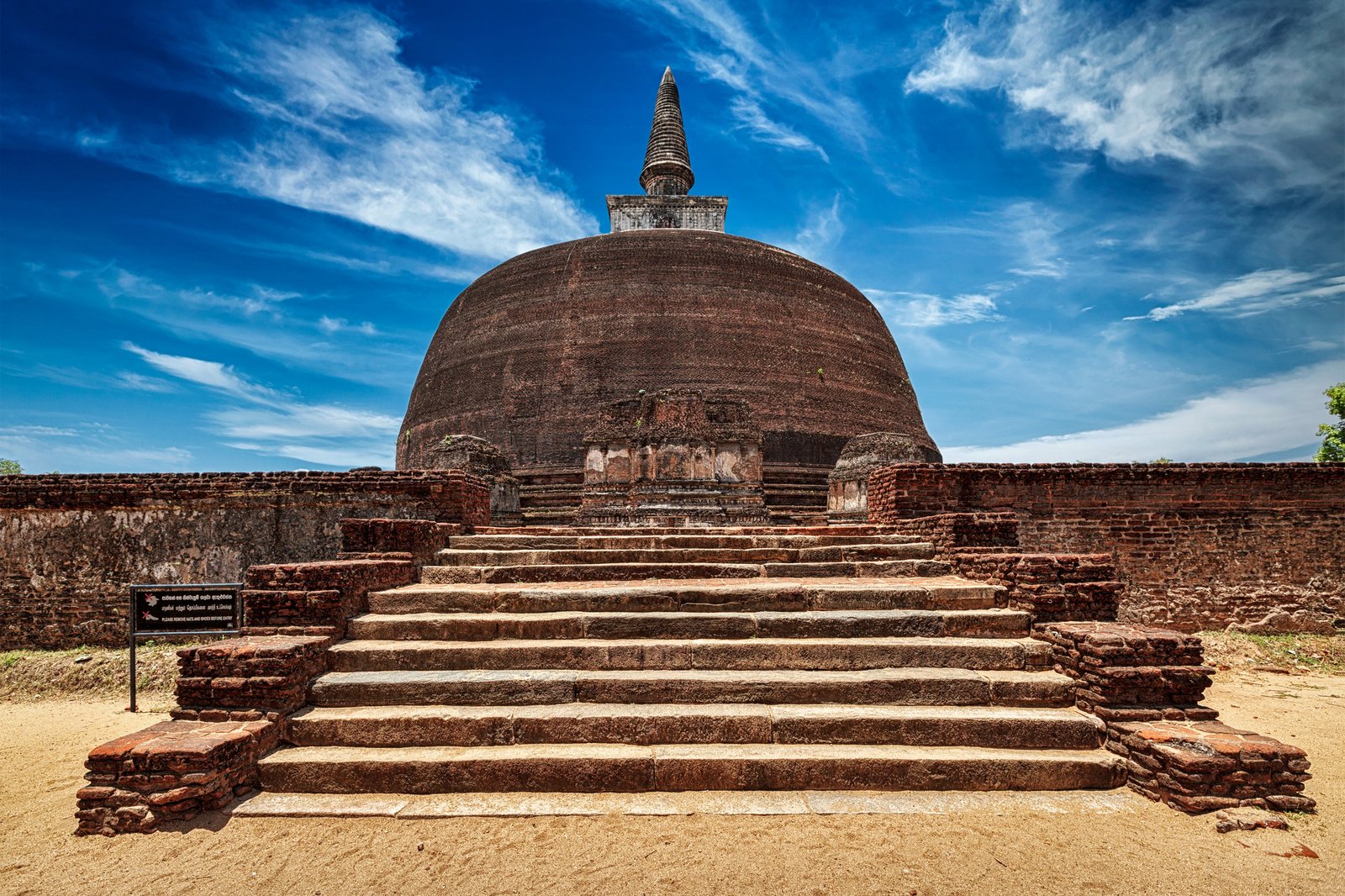
Some places you simply see. Sri Lanka’s Cultural Triangle is a place you feel. It’s the phantom weight of a crown on your head as you stand atop a rock fortress, the whisper of saffron robes in a 2,000-year-old monastery, and the humbling silence that falls as you stand before a mountain of sun-baked brick built to honour the enlightened one. This isn’t just a tour of old rocks and ruins; it’s a journey through the very soul of Sri Lanka, a land where history isn’t a chapter in a book, but a living, breathing presence.
The Triangle, a trove of UNESCO World Heritage Sites, is roughly marked by three ancient capitals: the sprawling Anuradhapura to the north, the elegant Polonnaruwa to the east, and the vibrant Kandy, the last royal bastion, to the south. Within this realm lies an astonishing concentration of sacred stupas, sky-high palaces, and cave temples that tell the story of a civilization powered by ingenious engineering and profound faith.
The Pillars of a Kingdom: The Big Three
To understand the Triangle, you must walk through its former hearts of power. Each one has a distinct personality, a different echo of the past.
Anuradhapura: The Sprawling Genesis
Imagine a city that served as a political and religious capital for over 1,300 years. Anuradhapura is immense, a testament to a kingdom at its zenith. This is not a compact site; it’s a landscape of wonders. At its spiritual core is the Jaya Sri Maha Bodhi, a sacred fig tree grown from a cutting of the very tree under which the Buddha is said to have attained enlightenment in India. Brought here in the 3rd century BCE, it’s one of the oldest living trees in the world with a documented history, its branches now supported by golden props, a silent witness to millennia of devotion.
Nearby, colossal stupas (or dagobas) like Ruwanwelisaya, a gleaming white dome, and Jetavanarama, once one of the tallest structures in the ancient world, punctuate the skyline. Renting a bicycle is the best way to absorb the scale of it all, pedalling between serene monasteries and ancient man-made reservoirs that still shimmer under the tropical sun.
Polonnaruwa: The Medieval Masterpiece
After Anuradhapura fell to invaders, the capital shifted to Polonnaruwa. What you find here is a more compact, well-preserved medieval city. The star attraction is the Gal Vihara, a stunning group of four Buddha statues carved from a single slab of granite. The serene seated Buddha, the enigmatic 7-metre standing figure (thought by some to be the disciple Ananda), and the magnificent 14-metre reclining Buddha are considered the pinnacle of ancient Sinhalese rock carving. Their detail and sheer grace, frozen in stone, are deeply moving. Beyond the Gal Vihara, you can explore the ruins of the Royal Palace, with its thick, time-worn walls, and the Sacred Quadrangle, a dense collection of beautifully decorated temples.
Sigiriya: The Lion Rock Fortress
There is nothing else on earth quite like Sigiriya. Rising a sheer 200 metres from the jungle floor, this rock fortress was the audacious creation of King Kashyapa in the 5th century. After seizing the throne, he built his palace on the summit as an impregnable fortress and a heavenly abode.
The ascent is part of the experience. You pass through the famous Mirror Wall, once polished so highly the king could see his reflection, now covered in ancient graffiti from visitors who marvelled at the site centuries ago. Halfway up, a sheltered pocket in the rock holds the Sigiriya Frescoes, ethereal paintings of celestial maidens. Finally, you climb through the monumental Lion’s Paws—all that remains of a colossal lion sculpture that once formed the gateway—to reach the summit. The windswept ruins of the palace at the top offer a 360-degree view that is nothing short of breathtaking.
Beyond the Capitals: Sanctuaries of Spirit and Art
While the ancient cities are the anchors, the Triangle’s soul is also found in its sacred sanctuaries.
-
Dambulla Cave Temple: A short drive from Sigiriya, this is the largest and best-preserved cave temple complex in Sri Lanka. For over 22 centuries, these five caves have served as a place of worship. Inside, the rock ceilings are covered in a kaleidoscope of intricate murals depicting the life of the Buddha, while over 150 statues of Buddha in various poses fill the spaces. The sheer volume of art and devotion packed into these cool, quiet caves is astonishing.
-
Kandy: The Living Heart: Kandy is not a ruin; it is a bustling city and the spiritual capital of the country. It’s home to the Sri Dalada Maligawa (Temple of the Sacred Tooth Relic), which houses Sri Lanka’s most important Buddhist relic. The belief that whoever holds the tooth holds governance of the country made it a symbol of sovereignty for centuries. The daily pujas (offering ceremonies), performed to the sound of traditional drumming, are a powerful and authentic experience. In July or August, the city erupts for the Esala Perahera, a spectacular ten-day festival in honour of the relic.
The Threads of Tradition
Exploring the Triangle is not just about looking at the past. It’s about seeing how that past lives on. You’ll see it in the white-clad pilgrims making offerings of lotus blossoms at Anuradhapura, in the Kandyan dancers whose movements tell ancient stories, and in the deep respect shown at every temple entrance. This is a living culture, where the traditions of kings and saints are woven into the fabric of daily life.
A Practical Guide for the Modern Pilgrim
- Best Time to Visit: The Cultural Triangle is generally hot and dry from January to October, making it an ideal time to visit. The current season is perfect for exploring.
- Getting Around: Hiring a car with a driver is the most comfortable way to navigate the spread-out sites. For exploring within Anuradhapura and Polonnaruwa, renting a bicycle offers a fantastic, leisurely experience.
- Temple Etiquette: This is crucial. When visiting any temple, ensure your shoulders and knees are covered. It is respectful to wear light-coloured clothing, preferably white. You must remove your shoes and any headwear before entering sacred grounds; be prepared for hot stone underfoot!
- Tickets: You can often purchase a “Cultural Triangle Ticket” that covers entry to several of the main sites, which can be more economical than buying individual tickets. Inquire about this at the first major site you visit.
You don’t just leave the Cultural Triangle with photographs; you leave with a piece of its timeline embedded in your own. You leave with the feeling of having walked in the footsteps of kings, monks, and artisans who shaped a remarkable and enduring legacy.